GMC-registered doctors · Personalised treatment plans · Harrow & Battersea
Dermal Fillers
Thoughtful enhancement. Individual balance.
Restore selected areas of lost volume, refine facial contours and enhance lip definition with hyaluronic acid dermal fillers at Clinic N°44.
Our doctor-led approach considers your face as a whole, with treatment tailored to your anatomy, proportions and personal goals.
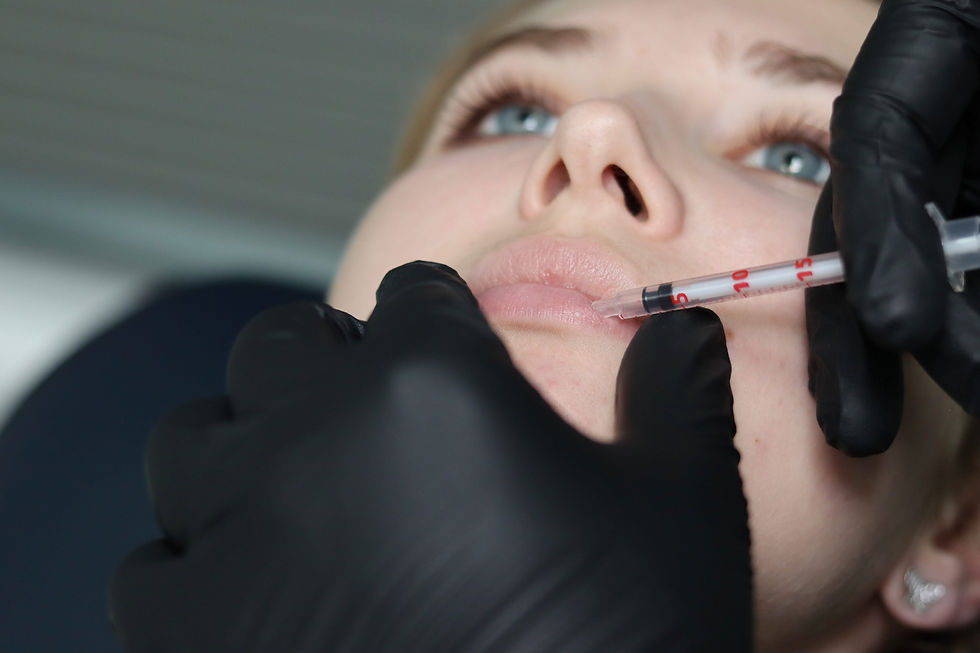
What Are Hyaluronic Acid Dermal Fillers?
Hyaluronic acid, or HA, dermal fillers are injectable gels used to restore volume, soften selected folds and enhance facial contours. Hyaluronic acid occurs naturally in the body, where it helps retain moisture and support tissue structure.
Different filler formulations offer different levels of softness and support. Your doctor selects the product and placement according to the treatment area and your goals.
Results are usually visible immediately, although swelling can temporarily affect the appearance.
Enhance lip definition, restore lost volume or improve selected asymmetries. We consider the shape of your lips, their movement and their relationship with your other features.
Restore selected areas of mid-face volume loss or enhance cheek contour. Treatment is planned around your existing facial structure and the level of support required.
Refine chin projection, improve profile balance or add definition along the jawline. Filler adds volume and structure; it does not remove under-chin fat or excess skin.
Soften the folds running from the sides of the nose towards the mouth. We assess the surrounding mid-face as well as the folds themselves before recommending placement.
Soften selected lines extending from the corners of the mouth towards the chin. Treatment depends on the contribution of volume loss, skin laxity and facial movement.
Restore volume in selected cases of temple hollowing. This area requires detailed anatomical assessment and a discussion of its specific risks.
Temple filler is a non-surgical treatment that uses hyaluronic acid (HA) dermal fillers to restore volume and contour to the temple area, which can hollow with age, causing a sunken or tired appearance. While safe and effective when performed by qualified medical professionals, some patients may wish to adjust or reverse their results due to aesthetic concerns, such as asymmetry or overfilling, or medical reasons, such as lumps or complications.
Benefits:
-
Volume restoration
-
Contours
-
Youthful appearance
-
Use carefully placed filler to camouflage selected contour irregularities and improve profile balance. Nose filler adds volume; it cannot make the nose smaller or correct breathing problems. It is a higher-risk treatment area and requires particularly careful assessment.
Hyaluronic acid dermal fillers are safe and effective when administered by qualified medical professionals, but sometimes patients may want to adjust or reverse their results. This can be for aesthetic reasons, such as overfilling, asymmetry, or dissatisfaction, or for medical reasons, such as lumps, complications, or vascular concerns.
Filler can be dissolved using a prescription-only enzyme called hyaluronidase, which safely and efficiently breaks down the hyaluronic acid.
The procedure is performed exclusively by a qualified doctor, ensuring maximum safety and precision.
Benefits:
-
Treats overfilling
-
Treats filler migration
-

Why Choose Clinic N°44?
Your care is led by Dr Ali Abas and Dr Ajmal Naqshbandi, GMC-registered doctors and NHS General Practitioners with postgraduate specialty training in general practice.
Our approach combines:
Medical Assessment
Review of your health, medications and previous treatments.
Individual Planning
Product and placement selected for your anatomy.
Clear Expectations
An honest discussion of benefits, limitations and risks.
Personalised Aftercare
Guidance on recovery, review and when to seek help.
FAQ
Our aim is an outcome that suits your existing features and proportions. Product selection, placement and the amount used all matter. We agree your goals before treatment, although individual results cannot be guaranteed.
There is no standard amount that suits every face. The quantity depends on the area, your anatomy, any existing filler and the change you would like to achieve. We recommend an amount after assessment and may suggest treating in stages.
You will usually notice a change immediately. Swelling and bruising can affect the early appearance, so results are generally reviewed after around two to four weeks, depending on the area and product.
Longevity varies considerably with the product, treatment area, amount used and individual response. Effects often last several months to over a year, and some filler can remain considerably longer. Further treatment should follow reassessment rather than an automatic top-up schedule.
Injections can cause discomfort. Many HA fillers contain local anaesthetic, and additional numbing may be appropriate. Temporary tenderness can occur afterwards.
Swelling, bruising, redness and tenderness are common. These often settle within days but may last one to two weeks or longer. Allow time before important events, especially after lip treatment.
Risks include bruising, swelling, infection, asymmetry, lumps, migration and delayed inflammatory reactions. Rarely, filler can block a blood vessel, causing skin damage or tissue loss. Visual loss, blindness and stroke are rare but serious potential complications.
Your doctor will explain the risks specific to your treatment area before you consent.
HA filler can often be reduced using hyaluronidase following medical assessment. Dissolving is not an exact or risk-free reversal: more than one session may be needed, and allergic reactions can occur. Dissolving filler also cannot guarantee reversal of damage caused by a complication.
Tear trough filler may help shadows caused by suitable under-eye hollows. It does not reliably treat pigmentation, prominent eye bags or fluid retention, and can worsen puffiness in some patients. We assess the cause before recommending treatment.
Filler may improve contour where loss of structural support contributes to the concern. It does not remove loose skin, and adding volume is not always appropriate. We will explain whether another approach would better address your goals.
Treatment is generally deferred during pregnancy or breastfeeding and where there is an active infection or cold sore affecting the area. Relevant allergies, medical conditions, medicines and previous filler all need review.
Tell us about recent or planned dental work and other procedures. Do not stop prescribed medication without advice from your prescriber.
The cost depends on the treatment area, product and amount required. Following assessment, we provide a clear quotation and explain any proposed staged treatment.